Last Updated on April 20, 2026 by Johann Holsinger
The short-throw projector can be the next great addition to your dream home theater.
The short-throw projector can be the next great addition to your dream home theater.
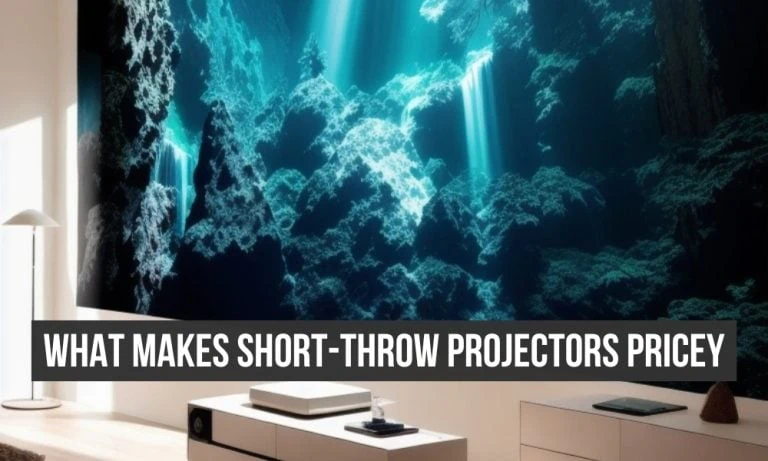
Imagine one that has to sit a few inches from the wall and could project a 120-inch screen with high-quality resolution.
The short throw projector is a beautiful promise to the market of projectors. However, they are also expensive. Not just expensive, but ultra-expensive.
We’ve seen lots of technology evolving so fast. But smart projectors seem to improve slowly compared to smart TVs. But when they do, they do it well and will surely break the bank.
Short-throw projectors sit around $1,000 to $3,000. So the next question is, are they worth the money?
Before we answer that question, let’s dig into their cost, which makes short-throw projectors expensive.

1. Advanced optics lens and mirrors
Short-throw projectors use lenses, unlike traditional ones. The lenses used for short-throw projectors are engineered for higher precision at short distances.
Regular short-throw projectors can project up to a 120-inch screen image at five feet, while ultra short-throw projectors can show the same screen size at less than one foot.
This explains why short-throw lenses are more expensive than regular projector lenses.
Many short-throw optical lenses boast advanced optical coating, which helps improve contrast, enhance light transmission, and reduce glare and reflections.
Here are the extra benefits you can get from short-throw lenses that take them more steps ahead of traditional projectors:
- No need to worry about people walking by your line of view.
- You don’t have to worry if you have limited space.
- Maximize your space for your surround sound installation or a modern soundbar.
- Using these lenses with ambient light rejecting screens makes viewing in environments with more ambient light possible.

2. Special screen requirement
You need to purchase a special screen for short-throw projectors. The Ambient Light Rejecting (ALR) screen works by reflecting the lights from the projector back to the viewers while rejecting the ambient light so it doesn’t interfere with the images projected on the screen.
Although technically, you can use a white screen for short-throw projectors, the results are different.
If you use a regular screen on an uneven surface with ambient light, image distortion will be visible. However, it doesn’t make much difference when watching under dim light.
If you use an ALR screen in ambient light, you’ll find the images more vibrant and bold, unlike when using a white or grey screen where the images are usually washed out.
The short-throw projectors are specially designed to work with ALR screens to enhance the images under such conditions, which makes them more expensive.

3. Use of laser light sources
Before, projectors used lamps and LED light sources. But going laser has become the new standard source for projectors and they are more expensive than the other two.
Using blue, red, and green lasers, a projector can create a vibrant, more realistic, and color-rich image.
Although, some short-throw projectors today use LED lights. LED is much safer than lasers, which are present in most smart TVs.
Laser projectors are brighter than other light sources and have a longer lifespan.
When you need to replace light bulbs for traditional projectors in their lifetime, you will never have to do that with laser light sources.
Also, manufacturers use their brightness figures as somehow a form of luxury that adds up to their price.

4. The promise of ease of installation
The demand for limited space installation, without having to set up or drill holes in the ceiling, is a huge pricing factor.
Many businesses have small spaces and being able to place the projector one to five feet away from the wall is heaven-sent.
To make this possible, manufacturers engineered short-throw projectors with complex and sophisticated modern optical systems.
Now that projectors can shoot a hundred-inch screen size a few feet from the wall, you don’t have to make complex installations, and you can keep your setup in one place.
You can pair it with a modern soundbar and don’t have to worry about placing independent speakers.
Most short-throw projectors even have auto-calibration features, so you don’t have to worry about setting up the projected image itself.

Are short-throw projectors worth the money?
Having that big screen in minimal space and less effort to install makes the splurge worthwhile.
I mean, you don’t have to worry about wires and perfecting ceiling location. It is worth spending on.
Just imagine the crisp, vibrant images in broad daylight. You can watch any time of the day with great image quality.
In this case, you are paying for convenience and technology. So, if you are looking for convenience, check the high-end short-throw projectors in this list to complete your home theater dream.
However, the cost can be too much. Some projectors produce the same image quality at a considerably lower price.
However, they don’t offer the novelty and convenience of installation of short-throw projectors. So, get your preferences straight before spending!