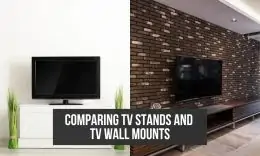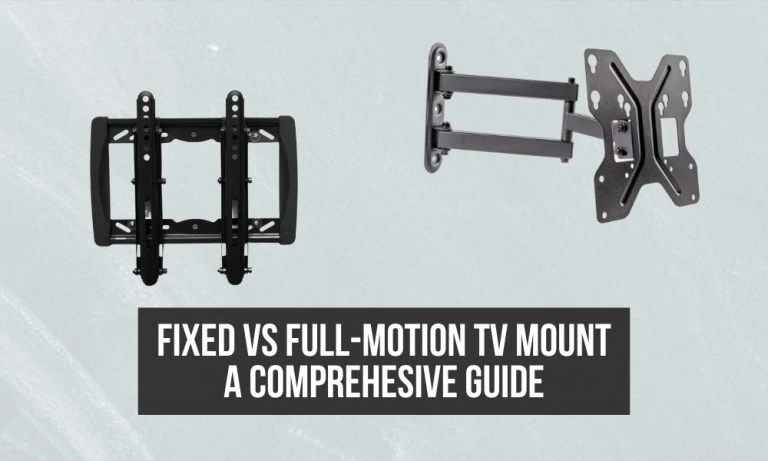
- Torn between a fixed vs extendable TV mount?
- Why is a Fixed TV Wall mount Better than a Full-motion TV mount?
- Why is a Full-motion TV Mount Better Than a Fixed TV mount?
- Durability
- Design
- Movement
- Installation
- Cable management
- TV Sizes
- Stud Spacing
- Weight Capacity
- Wall profile
- Mounting Options
- Fixed vs. Extending TV mount: Which One to Choose?
We are independent, red buttons are affiliate links and approved purchases help support our guides at no extra cost to you. Learn more.

Last Updated on April 18, 2026 by Johann Holsinger
Torn between a fixed vs extendable TV mount?
It’s not every day that you’re going to browse for a brand-new TV wall mount for your living room.
But when you do, you’d probably get overwhelmed at first with the range of TV mounts found on different shopping platforms and the full range of what is available!
The fixed vs extendable wall bracket debate is among the top new home buyers’ favorite living room decisions, one that I have helped many homeowners make when servicing home theater systems and AC units.
Even for their obvious differences, a lot of people are still confused about which one is best for their wall.
To help you decide, we rounded up the most important features and reasons and compared the important metrics for your reference; for an easy, quick decision.

Why is a Fixed TV Wall mount Better than a Full-motion TV mount?
We loved a fixed TV wall mount for simplicity. Being able to flush mount it on any wall with such a narrow distance is a great space saver compared to an old cabinet.
Unlike a full-motion extending wall bracket, you should always have free space anywhere around the extendable arm to get a full range of capabilities.
The good thing about a fixed mount is that you can rest assured that the weight of the television is distributed evenly on the entire bracket when mounting on a wall stud.
Whereas an extendable wall mount does not take the entire weight of the monitor on the base. Instead, the TV’s weight becomes a fulcrum that may break the bracket if not durable enough or installed properly.
Your television is set to only one place, and you don’t have to always move your unit around to new and exciting positions.
I would prefer a fixed TV mount in the traditional home living room because everyone can have another reason to gather in the house as a family.
The television serves as a backdrop, and you don’t want kids playing around it.

Why is a Full-motion TV Mount Better Than a Fixed TV mount?
We love the innovation that goes into a full-motion extendable wall mount.
Because the full motion function allows you to place your monitor in any place and still find time to adjust it to your viewing angle.
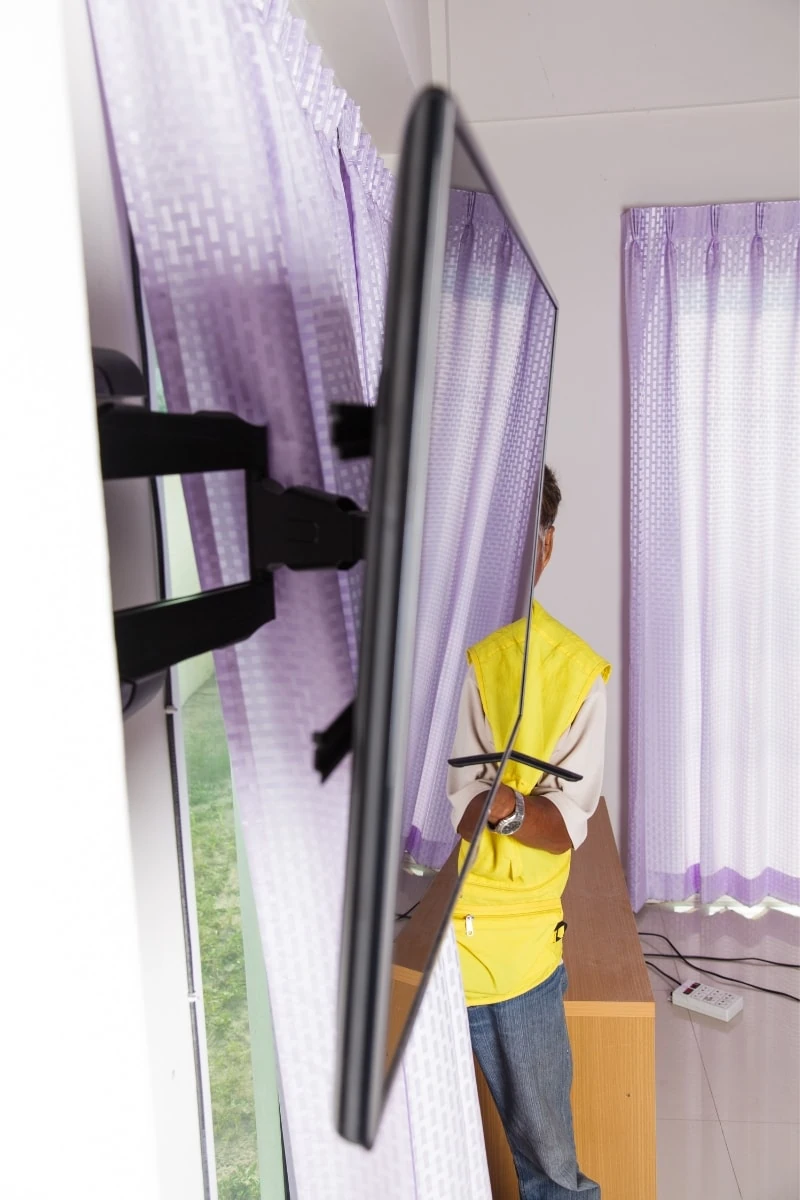
Unlike the fixed TV mount, this unit tilts up and down, swivels to the right and left, extends out, and flushes to the wall when you want it out of the way.
There are two types of full-motion brackets: The one with a single stud installation and the one you can mount onto two studs.
There’s also another type of full-motion TV mount that you can flush onto a recessed wall. With a plated base specifically for installing recessed in-wall.
We love this innovation as you can flush him directly on the wall with a lower profile.
However, we’ll focus on single and dual-stud articulating mounts because they are simple to install and don’t require a qualified builder for installation.
Now the reliability of these brackets depends on the screws you use for the installation, especially if you’ll install your first televison against the drywall.
If you use the right fixings, you’ll get to enjoy the flexibility of an articulating bracket without putting stress on the mounting plate.
I would disagree that the extendable TV brackets should not be used for large screens up to 100 inches.
In fact, some extendable mounts can take up to 220 lbs of weight. All you need is the right location, screws, and installation procedure.
But if you have a large flat-screen television, our initial tip is to get a dual-stud full-motion TV mount. The weight limit of a single stud full-motion bracket is 80 lbs [1] and can be prone to tilting out of level on cheaper brackets.

Durability
There’s not much difference between the two they both make your television more earthquake-safe depending if there is an upward motion lock.
If we’ll talk about the material that made up the brackets. Most TV mounts are made with alloy steel.
Alloy steel is an alloy of different types of metal: nickel, vanadium, molybdenum, aluminum, chromium, and more.
These alloying elements increase the strength, wear resistance, hardness, and toughness of the bracket.
So when you think of what makes up a fixed or full-motion TV mount, well, they are made of durable alloy steel, which is comparably stronger than stainless steel. Well, I haven’t seen such a mount with SS composition.
So, in this case, our verdict would be equal.
If there’s anything we should compare, the two TV mount types first are their structure and design.
But you have to consider the durability of any moving parts on a full-motion wall bracket.

Design
Here’s where things get exciting. With the less complexity of a fixed TV mount, you’d surely think that the fixed TV mount took less effort to make and install.
Fixed TV mounts
A fixed TV bracket has different types too.
There are a few who still uses a single stud fixed mount, which has a base and an adapter plate with flexible mounting holes.
Expect a mechanism where you can slide the adapter plate onto the base and lock everything in from there.
When installing your television to this type of bracket, you’ll just have to screw the adapter plate onto the TV and the single stud base onto the wall.
All you have to do is slide them together to fix the parts together. Others would have locking knobs to secure the base and adapter together.
The commonly used fixed mount has a frame that enables mounting onto two studs. Using two detachable adapter brackets with flexible mounting patterns to accommodate different TV sizes.
Some fixed TV mounts have quick-release locking mechanisms to secure the brackets onto the frame.
You can also observe the adjustable option to slide the adapter left and right on the frame.
Some fixed TV mounts do not use a frame but a single-line horizontal base attached to the wall.
In this design, you can slide the adapter brackets, and they are also adjustable to the left and right.
Don’t worry because the adapter brackets have spring-loaded locks to secure the adapters onto the mounting base.
The adapters can also take different mounting patterns in this design.
Full-motion TV mounts
A full-motion TV holder comprises three major parts: the mounting base, the pivoting arm, and the adapter brackets.
The mounting base can either be a single-stud or a dual-stud base.
Dual stud bases are normally compliant with any stud spacing requirements, which can either be 16”, 18”, or 24”.
The pivoting arms swivel left and right at 180 degrees. Everybody loves the feature of pivoting arms.
Some brackets have single or dual pivoting arms. This allows you to extend the bracket in full and in half.
You can mount a bracket with a single-pivoting arm in the corner too.
In our database, the longest pivoting arm extends the TV up to 47 inches from the wall!
You never have to worry about sun glare or not getting the perfect close-up ever again!
The adapter bracket is where the back of your TV attaches to and is detachable.
The detachable adapter bracket can be a frame with a two-piece adapter or a plate. In either type, mounting patterns vary and can accommodate different TV sizes.
Which is more reliable?
Both are reliable as long as installed correctly. The reliability of their design relies on your installation.
But if I had to choose, the budget fixed TV mount is more reliable compared to a budget extendable mount both claim that the mount can take the weight of the monitor entirely.
Unlike the full-motion mount, you can have the chance to shift the weight on the adapter plates, which are not directly supported by the wall.
But installing on a concrete wall and stud with correct fixings will make this type of mount rock hard under the surface.
A full-motion mount requires strong arms so that the TV does not noticeably tilt out of level when extended.
But the reliability of shifting your TV position close to the audience and away from other people in the living room that are focusing on board games or something else can be a great hack for small spaces.

Movement
Fixed TV mounts
Except for the sliding movement you can do with the adapter plates, there is no other way you can move this mount to adjust the angle to your desired viewing location.
Direct mounting makes a great idea for monitors that are part of home theaters with perfectly positioned seats directly angled for the LED screen and won’t require any adjustments of the TV’s location.

Full-motion extendable TV mounts
An extendable TV mount has so much to offer.
Your living room and sofas can be focused on sociability and comfort, and you can move your television easily to the right position when the evening comes time for visual stories instead of moving your heavy sofa, which can cause damage to elderly folks or the walls if not moved patiently by children.
These mounts can be pushed out, tilted up and down, and swiveled to the right and left.
The tilting movements that a full-motion can do vary from model to model when tilting.
Some full-motion mounts use a knob to adjust the TV position up or down and most tilt up to 5°.
And the lowest range these mounts can tilt to, according to the data we gathered, is 16.6°.
When home entertainment comes to swiveling motions, the common range is 180° or 90° to the left and right.
The swiveling motion varies if the mount has a dual or single pivoting arm. The most flexible swiveling movement we found today is Mount-It! M1-372, which swivels up to 270°

Which is more flexible?
A full-motion bracket, no doubt is like the perfect yoga master of TV wall mounts.
Installation
Well, obviously, a full-motion mount will take a few extra steps to install the TV mount.
When your DIY task comes to determining the height of the TV bracket, we have a separate article for that.
Fixed TV Bracket
When installing a fixed TV mount, you will have to attach the main base to the wall.
Ensure that the bracket is leveled properly.
Then you will screw the back of the TV on the adapter bracket(s).
The last step will be joining the parts together by sliding the adapter on the base for locking.
Although less function seems simple, you will need someone to assist you still. The process has one less step but is the same as any other mount.
Articulating TV mount
The adapter plates or brackets are detachable from the pivoting arms. And some manufacturers ship the units pre-assembled.
You only have to measure mounting height and placement because the position is movable to a large extent!
You just need to screw part of the mount to the back of the monitor and then fix the other bracket to the wall.
Secondly, sit the two parts of the bracket together. And Wa-La!
You would be wiser to choose a full motion with a spring-loaded locking mechanism for added security from bumps and shakes.
If you need an assistant to lift the television onto the wall bracket when installed, ask one of your neighbors!
Which is easier to install?
Both ideas need help from a partner.
The level of difficulty seems to be equal.
You will only have to add a few more steps on a full-motion TV mount, like calculating the distance of other objects around the TV.
If you are going to mount it in the corner with a full-motion TV mount, you will need more considerations too.

Cable management
Fixed TV mounts
Some slide-in fixed TV mounts have in-wall cable management features.
In most cases, you’d still have to set up your cable management system, depending on your preference.
Full-motion TV brackets
The cable management system is available on full-motion TV mounts, and this availability depends on the model or brand.
Some of the manufacturers provide sleeves or slots to hang the cables on the pivoting arms, so the cable or wires do not hang too low.
Which is tidier?
We can really appreciate the cable management on an extendable TV mount as they allow the wires to move together with the pivoting arms without dangling messily.
Fixed TV mounts are normally seen in museums or libraries’ halfway walls without the intention of impressing movie lovers.
But rather to show of a sleeker fit.

TV Sizes
To summarize, both can accommodate different TV sizes, and any size depending on the show.
Fixed TV Brackets
The TV size that a fixed TV mount can accommodate depends on the model you set your eyes on.
The screen sizes inclusive are usually disclosed in the description of the selling platform you are using. We also give a good rundown for you.
In our database, the smallest size is 17 inches, and the largest screen size is 100 inches.
Full-motion TV brackets
Again, sizes differ based on the full-motion bracket models. The smallest size we found in our database is 13 inches, and the largest is 100 inches.
Stud Spacing
Both types of mounts follow the American standard for stud spacing.
Fixed TV mounts
Our database lists from the job sites we work on are 8”, 16”, 18’, and 24” stud spacings.
Full-motion
For full-motion TV mounts, we find stud spacings 12”, 16”, 18”, and 24” in timber-framed houses are all suitable.
Weight Capacity
Again, the weight capacity will depend on the rating for each model. But in most cases, their ability to hold the TV will depend on the weight capacity rating, wall type, stud mounting, and fixing options.
The design is a secondary factor since these products are researched and designed to accommodate the maximum weight.
Fixed TV mounts
A fixed bracket has a more compact design to accommodate heavier weights.
The lightest a fixed mount carries is 55 lbs, according to the data we gathered. The heaviest general TV brackets available from the factory can hold up to 220 lbs.
Full-motion TV mounts
A full-motion can take monitorss in rated weight capacity as long as installed in good condition.
The weight capacity varies from 66 to 220 lbs.
Which one loads better?
A fixed TV mount. But a full-motion TV bracket loads better too when mounted with the right hardware.
Wall profile
Obviously, fixed TV wall mounts are slimmer. But there are reasons why some homeowners need to give up the space for extending arms.
Fixed TV wall mounts
Fixed TV wall mounts are extremely space-saving.
We have documented as slim as 0.4 inches of fixed TV mount from the wall. The farthest distance from the wall we recorded is 2.75 inches for a fixed TV wall mount.
Full-motion TV wall mounts
Let’s disregard the extendable length of the arm.
We also have data on the slimmest profile of full-motion mounts when retracted to the wall. The slimmest full-motion mount we found came from Vogel, which is 1.4 inches.
This slim articulating TV bracket can extend its arms up to 25 inches and take OLED TVs of 400 x 400m VESA.
The deepest mount we found has a distance of 4.5 inches from the wall to the bracket.
Mounting Options
Fixed TV mounts
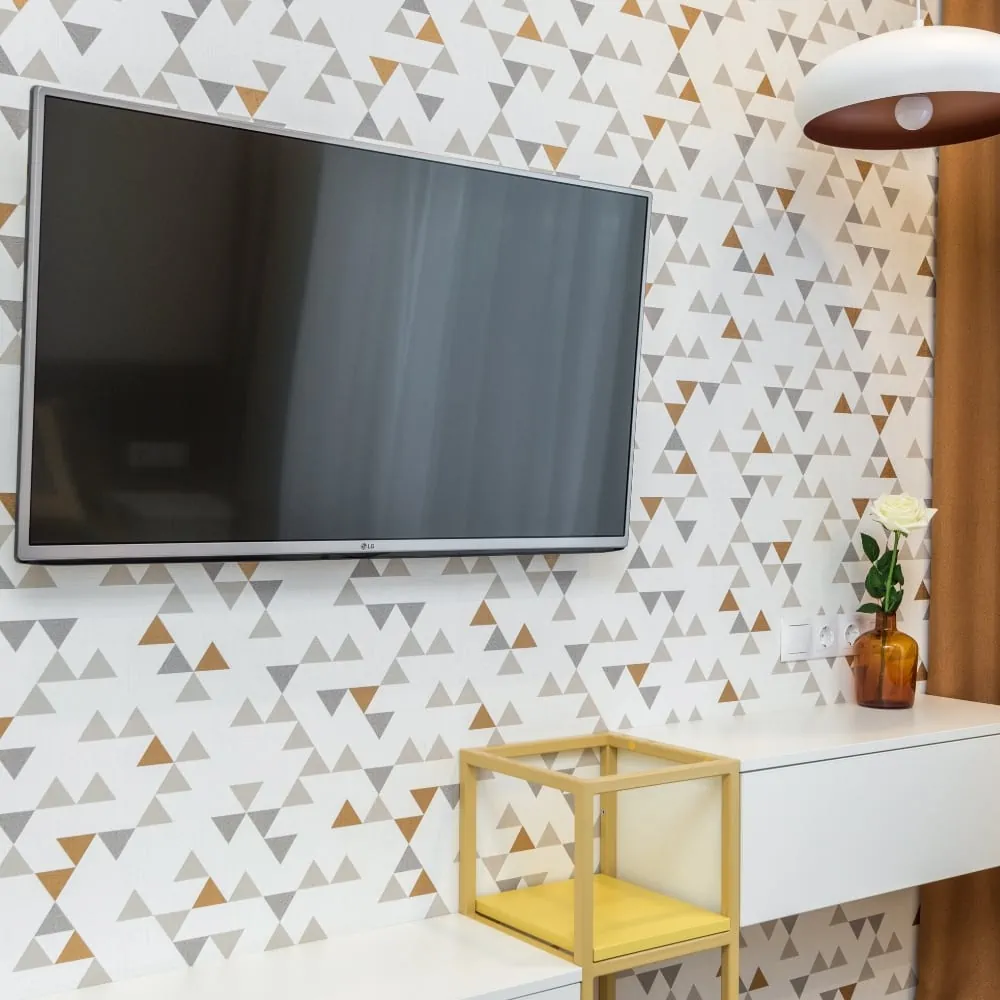
A fixed TV wall mount is best used on the wall above your console table, where you have decided never to adjust the position again.
You might want a mount that blends in with the furniture well, and you might have better options for managing the cables.
Or if you are planning to set up a home theater system, a fixed TV mount is appropriate.
A fixed TV wall mount provides the best support for monitors compared to other mounts.
While placing your bad boy above a fireplace don’t think you have a bad idea because of the limited adjustment capacity, there’s a more efficient TV mount above the fireplace, that will drop right on down for ya.
You can also use this technology under the kitchen cabinet, but you’d have to drill down into the wall.
A more appropriate wall mount is better under a high kitchen cabinet.
Finally, you can mount it straight in your bedroom! However, you can only watch comfortably while reclined or seated because it does not tilt.
Full-motion extendable mounts
A full-motion has more options for mounting.
You can install your unit in the corner or at higher parts of the wall because of the swiveling and tilting functions now at your disposal.
You don’t have to worry much about the height but get eye level close to where you want so that you don’t have to adjust the tilt too often.
However, if know exactly the location you want for your television is above a fireplace, you should still buy a fireplace TV mount.
You can also mount at unlikely locations, such as corners of the hallway or your living room or bedroom.
Sometimes you want to adjust the monitor to give a better view from your living room and, later, from the dining room table if the kids are away on school camp.

Which is more flexible?
A full-motion, no doubt.
Fixed vs. Extending TV mount: Which One to Choose?
Considering reliability, flexibility, and innovation, a full motion TV mount stands out against a fixed mount (← Check our link). However, we cannot disregard the ease of a fixed TV mount’s simplicity, strength, and space-saving features in dedicated home theaters or on the walls of libraries and museums.
Here’s a tip for you to decide which is best. Before you buy, document your monitor’s screen size, weight, location requirements, stud spacing, and applications.
Answer these questions: do you want your television fixed in one area, or do you want to have the flexibility of moving around? Do you want your TV closer when watching movies for a more impressive theater experience with a smaller 32-inch screen?
Also, consider your wall type. Are you going to mount it on a concrete wall or onto drywall?
If you’re going to mount it on drywall, you need to have the right fixings, studs, or tools. A fixed TV mount is better for this.
If stability is not an issue since you’re going to mount directly into studs or on a concrete wall, go for a full-motion TV bracket.
A full-motion TV support carries a lot of possibilities, you can use all the options around, and if you want to change rooms. Good luck!
More information:
- TV weight: Fact and Fiction a publication by https://www.omnimount.com/portals/0/images/news/ext/2013-06_CNET.pdf