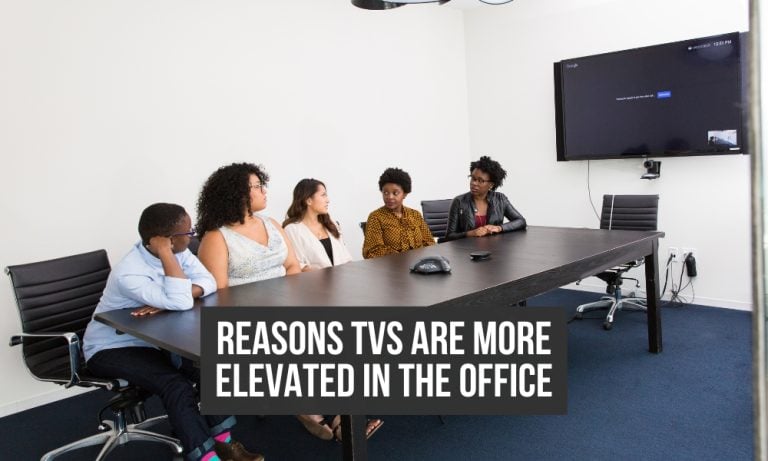
- Do you know why businesses mount a TV higher in an office?
- 1. Heightened visibility
- 2. Save space
- 3. To protect from damage
- 4. Privacy
- 5. For signage purposes
- 6. Ergonomics
- 7. To reduce glare and reflections
- 8. Cable management
- 9. Enhanced sound distribution
- How high is enough to mount a TV in an office?
- Here’s a small rundown on why you should mount a TV higher in an office.

Last Updated on April 20, 2026 by Johann Holsinger
Do you know why businesses mount a TV higher in an office?
Do you notice that most commercial establishments also make use of TV mounting hardware overhead to bolster a professional image?
It is true that even when the television is mounted on the wall, you can see televisions being hung way higher than the height of home televisions.
TVs are also installed overhead for public places such as customer lounges.
Offices cannot simply apply the concept of general viewing height for TV home placement. Here’s why.
The office and TV setup
Offices are busy places with members who communicate, collaborate, and work from their respective desks.
To collaborate efficiently, they use a visual communicator, the television, which distributes information as widely as possible.
For busy people, it is crucial to retrieve more information at the soonest possible time.
LCD screens are a great way to disseminate announcements from one department to another. In conferences, televisions are great tools to display presentations.
With the number of people the display must reach from different angles, offices must put the monitors in higher positions on the wall or ceiling.

1. Heightened visibility
Installing TVs on higher spots in the office ensures everyone – including those at the farthest desks or from various viewing angles – can get a good view. In this spot, the view is unobstructed.
In a conference room, for instance, the farthest participant on a large oval table can view presentations and see visual graphics.
Even the employee at the farthest desk in an office room can still view the announcements and information display.
Picture yourself in a queue of banks.
Whether you sit from the farthest seat, stand from afar, or switch seats in the opposite direction, you can still view the number being served from the screen.

2. Save space
Mounting a TV higher in an office saves vertical and floor space. For an office with limited area and many occupants, space is very crucial.
A higher mounting height helps reduce the clutter of having a physical television on the floor and wirings that could obstruct high-traffic areas.
Another thing we love about higher TV mounting in an office is it enhances the room’s layout and creates a modern, minimalistic look.
So even if you have a limited space with a screen in the office, it can still look spacious.

3. To protect from damage
Mounting a TV higher in a busy place like an office protects the hardware from damage.
The elevation reduces the risks of physical contact because the television does not get in the way of passers. For this reason, the TV is less likely to be bumped, tampered or touched.
The TV will have fewer chances of tipping or falling when secured by a reliable ceiling mount.

4. Privacy
In conference rooms where few members gather, the TVs are even higher unlike a classroom setup.
The TVs are higher not only because the farthest seated participant needs to see the screen but also to prevent onlookers from seeing the information displayed on the TV.
See, some offices present confidential information, and only authorized individuals can access or see the information displayed.

5. For signage purposes
The second purpose of using a mounted office TV is for signage purposes.
To have the warnings, instructions, announcements, or advertisements reach more people faster, you can mount the TV on the ceiling, where the display can reach a broader audience.
For real-time updates, emergency alerts, goal notifications, and flexibility, the screens should be viewable from different spots, desks, seatings, and corners of the office.

6. Ergonomics
Ergonomics plays a crucial role in enhancing productivity. Comfort boosts an employee’s cycle time by 18 % and the lean process by 27% [1].
Businesses must help employees overcome the challenges of longer presentations, indirect seating arrangements, and longer working hours by ensuring that visual displays do not cause neck and back strain.
This is where higher TV mounting options take place. If you are watching at an elevated screen at the right height and distance, it will not strain your neck.

7. To reduce glare and reflections
Mounting a TV at an elevated height can also reduce glare and reflections but only under favorable lighting conditions.
The elevation itself reduces the impact of direct light sources, such as the windows and overhead light.
Any beams of light in these circumstances should not hit the screen directly if the screen is mounted higher from the rays coming downwards from the window openings.
Also, elevating your television helps position the screen from reflective surfaces such as glass or glossy countertops and tabletops in an office space.
A good mounting position improves viewing angles, especially if you adjust at certain angles with motorized ceiling TV mounts using a wireless remote control.

8. Cable management
You can find it easier to hide TV wires when installed on a ceiling. You can set up an in-ceiling TV wire routing system for a cleaner look.
As you know, cable management is crucial in an office setup, especially for high-traffic areas, even if the television is mounted on the wall. For conferences, any type of clutter or dangling cables can distract participants or clients.
You can route the cables vertically inside the wall or set up cable raceways. Either way, this option still reduces clutter and minimizes the tripping hazards of wires.
9. Enhanced sound distribution
Mounting a TV higher makes it possible to position external speakers more strategically at the ear level of seated people.
This placement can improve the sound quality and viewing experience by delivering the sound directly to the audience’s level without bouncing off odd angles or surfaces.
There should be minimal sound obstruction. Employees and audiences can pick up information efficiently from visual displays and sounds.

How high is enough to mount a TV in an office?
While there is no one-size-fits-all, you can mount a TV at eye level and higher.
That could be around 42 to 48 inches off the floor. A good technique is to measure the viewing distance from the farthest seat.
If you want to save yourself from the trouble of measuring viewing height, and permanent position a good choice is to mount it with an adjustable mobile TV stand.
TVs can stand at about 60 inches in height. But for assembly rooms, you have to raise it higher, considering the seating layout.
If you will mount the TV from the ceiling, consider the drop distance and your desired viewing angle.
Most ceiling pole TV mounts can tilt by -25° and drop up to 60 inches from the ceiling.

Here’s a small rundown on why you should mount a TV higher in an office.
Mounting a TV higher in an office yields numerous benefits for the organization in your office.
With streamlined communication, enhanced collaboration, a clutter-free environment, and working convenience, higher televisions become an efficient tool in an organization.
When mounting a TV higher in an office, consider the seating arrangement or layout. In the end, this procedure is about improving the overall experience, productivity, and well-being of your clients, employees, and your company.

More information:
- Employee productivity statistics report from https://www.bostontec.com/ergonomics/employee-productivity-statistics/