- Mounting a 75-inch TV on the wall
- How is mounting a 75-inch TV different from other TV sizes?
- Terms to remember
- What is the center measurement of a 75-inch TV screen?
- How to measure your eye level?
- Up to how much viewing angle is ideal for a 75-inch TV?
- What is the role of viewing distance when calculating the height of a 75-inch TV?
- What other things should you consider when mounting a 75-inch TV?
- Mounting a 75-inch TV in the living room vs the bedroom
- Putting everything together: How to work out the height of your 75-inch TV?
- How does a height-adjustable TV mount help for different viewing locations?
- How does a pop-up TV mount solves the problem of heightening your 75-inch TV?
- What if you had only the space above the fireplace?
- Full-motion vs. Fixed TV mount
- Have you made up your mind?

Last Updated on April 18, 2026 by Johann Holsinger
Mounting a 75-inch TV on the wall
Having a wall-mounted TV is great for many reasons. With larger TVs, calculating the right height and viewing distance becomes more critical, especially with 75-inch screens.
Mounting your TV on the wall gives you extra space in your room, gives added security, and allows for better cable management.
Most importantly, mounting on the wall puts it in the perfect position for your best viewing experience, especially with a movable extendable arm.
Finding the perfect mounting height for a 75″ screen is important and requires a few calculations but is well worth the home improvement to your home theater in the end.

How is mounting a 75-inch TV different from other TV sizes?
Your 75-inch monitor will be measured diagonally, as most television and monitor screens are measured. Smaller televisions will be measured the same, but a few inches difference can mean much less overall viewing area.
For example, a 65-inch screen is roughly 5 inches shorter in vertical measurement than a 75-inch screen would be.
However, this minor difference can entirely change the general best height placement when mounting on the wall.
Additionally, a smaller TV may work better with a higher angle or tilt than a large TV due to the size and arrangement of the LCD components.

Terms to remember
- Center of the TV. The perfect center of the television is if you were to place lines in an X from each diagonal corner.
- Viewing angle. The amount of tilt a TV can have to provide the best glare-free viewing experience.
- Viewing distance. The distance you should sit to be able to enjoy the TV in full color and without eye strain.
- Eye-level. The best viewing height for a 75-inch screen, so your neck does not get fatigued by having to look up or down.
What is the center measurement of a 75-inch TV screen?
To know how high to mount 75″ monitor on the wall, you can find the perfect center of your screen by placing two strings from each diagonal corner and marking the area where they cross in the middle with light-duty painter’s tape.
This is the center.
When DIY leads to measuring the perfect height placement, measure the actual viewing screen of the television from top to bottom.
This vertical measurement can then be divided by 2 for the center measurement.
The center height for most 75″ telly is around 36.8 inches [1]. Dividing your TV height by 2, you’ll get 18.4 inches as the center of the screen vertically.
You’d also need to get the center of the width of the screen to use when mounting on the bracket.
While size is usually advertised at 75 inches, the actual width horizontally usually goes from 65 to 67 inches.
Divide this into two, to get the center point by width.
How to measure your eye level?
When sitting comfortably, look at a point on the wall directly in front of you. Mark this spot and measure it.
What is the average height for a 75-inch TV? For average-sized adults, this height is probably around 40-42 inches from the floor. This would be your eye level when seated.
You can also sit comfortably and use a tape measure to measure the distance from the floor to your eyes. Either method works in a very similar way, but one may be easier than the other for you to do.
These measurements are averages, however.
If you are a different height than average, your results will be different.
When deciding on the optimal height for a 75-inch television, always take your personal eye level into account rather than using the averages. You want to be comfortable when viewing your TV, no matter how tall or short you may be.

Up to how much viewing angle is ideal for a 75-inch TV?
Many wall mounts allow you to adjust the viewing angle of the telly either vertically or horizontally.
This is excellent when mounting a TV in a bedroom where you may be laying in bed or have your eye level much lower than usual.
Adjusting the angle to better suit your viewing position can improve the color, brightness, and gamma of what is being shown on the screen.
Always be sure to adjust the angle to your liking, within what the wall mount can handle safely, to ensure you get the best viewing experience possible.
The Society of Motion Picture & Television Engineers that viewing discomfort begins at an angle of more than 35° [2].
Take note that TV height is better when you have a monitor tilting downwards rather than upwards.
This is better for your neck, so make sure to position it for you and your partner’s highest viewing position.

What is the role of viewing distance when calculating the height of a 75-inch TV?
Finding the best viewing distance to place your seating furniture is important and very easy to calculate.
Simply take the diagonal measurement of your screen and multiply by 1.5.
For example, a 75-inch monitor would come to 112.5 inches.
This means you should place your furniture around 9 feet away from the center of the TV to your eye level for the best results.
Higher televisions would allow the furniture to be placed closer, while those close to eye level would require the full 9 feet, or perhaps, even more, to be considered the perfect distance for the best viewing outcome.
What other things should you consider when mounting a 75-inch TV?
1. Your furniture.
If you have a single sofa directly in front of a TV, you won’t need to worry about its angle.
Additional seating on the sides of the television as well may require additional adjustment when mounting.
2. Aesthetics.
This may require you to select a specific type of wall mount or color (black), or perhaps even forego the wall mount and go with a stationary cabinet stand instead.
3. Your soundbar.
Ensuring there is a proper and suitable place for your soundbar is important.
Some can be mounted on the wall below the TV, while others will need to be on a surface nearby.
A dual soundbar shelf attachment can even take media players apart from a soundbar.

4. Your room constraints.
The size of the room and available space for seating can limit your choices for TV placement.
Consider mounting your it in the corner or above the fireplace if space is limited.

5. Kids in the house.
Children can cause damage to TVs they can reach, as well as put annoying fingerprints on the screen.
By wall-mounting the TV, you not only help ensure it cannot be bumped or touched by small ones, but you help prevent the risk of your expensive electronics being tipped over and breaking or hurting someone.
6. Cable management systems.
Having a TV wall mounted gives you more opportunities for cable management both on the wall as well as inside or behind the wall.
Mounting a 75-inch TV in the living room vs the bedroom
Living room mounting
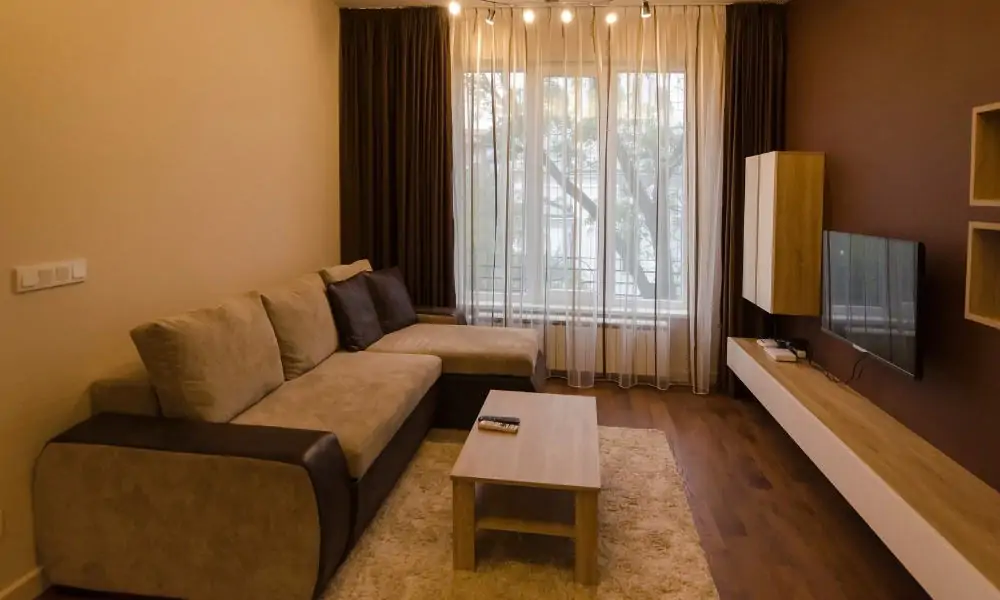
Living room mounting for your TV should have the TV mounted at the proper eye height as well as viewing distance.
Position your seating to ensure the best view for everyone involved. Also, keep in mind the following:
- Space available.
- Glare from the windows.
- Rising heat from a fireplace.

Bedroom mounting
Bedroom mounting is similar, but the height of the television can be higher since you will normally be lying on a bed while watching your favorite shows looking at an upwards angle.
Your average eye height should be lower than if you were sitting on a couch.
Otherwise, the center height of your 75-inch TV should be lower if the bracket is mounted in your living room and the viewing distance is in a shorter range.
Here’s the ideal TV height mounting for inside bedrooms as laying down position changes everything.

Putting everything together: How to work out the height of your 75-inch TV?
You want your TV to be mounted slightly above your eye level, tilting downwards.
The easiest way to work out the best height for your TV placement is:
- Determine your eye level measurement. 42 inches is the average for most adults.
- Determine the middle of the TV. This can be done by dividing the vertical measurement in half.
- Take your eye level measurement, and subtract the vertical measurement from it.
- This number result is how high the bottom of the TV should be for the best viewing experience.

How does a height-adjustable TV mount help for different viewing locations?
TV mounts with a high range of motion are an excellent option for large rooms or those that have a variety of seating positions.
Regardless of where you want to sit, the TV can be adjusted to give you the best viewing experience.
You can also ensure glare is kept to a minimum throughout the day, regardless of whether the curtains are closed or not.
By simply adjusting the tilt or angle of the television, you can entirely eliminate glare on the screen.
Pop-up TV mounts can also be used to arrange for different viewing heights.

How does a pop-up TV mount solves the problem of heightening your 75-inch TV?
Wall mounting may not be for everyone, but pop-up TV mounts can work just as well.
Your TV can be raised from a cabinet or lowered from the ceiling to the perfect viewing height.
You can also adjust the height with the press of a button, as well as adjust the tilt or angle on several models as well.

What if you had only the space above the fireplace?
Many TVs are mounted successfully above the fireplace.
As this is one of the most common areas of wasted space, a TV will work fine here.
Above-fireplace mounts allow freedom of movement to adjust the TV down towards a proper eye level and can also easily lift up and out of the way when not in use.

Full-motion vs. Fixed TV mount
Sometimes homeowners make the mistake of first buying a fixed TV wall mount and then later deciding before installing that they should switch to a flexible full-motion TV wall mount, find out why here.
Full-motion TV mount
Full motion mounts are, in most cases, the best option for average homes and large TVs.
Being able to make small adjustments with the height/ tilt, position, or angle can improve the color, brightness, and overall quality of the show or movie you are watching.
Fixed TV mount
Fixed wall mounts are more affordable and just as secure but do not usually offer a way to adjust the tilt or angle of the screen.
In addition, you must be sure that the height you install the TV is perfect, as you cannot adjust the position without completely removing and remounting the entire bracket.
Have you made up your mind?
While figuring out the perfect height to mount your 75” TV, as well as the best distance to place your furniture for viewing, only needs a bit of time and a small amount of math, the end result is well worth the extra effort, most people don’t put in the time to work out the perfect height.
Ensuring you and your family get the best viewing experience can turn an average large TV into a true cinema experience in the evening in your own home theater.
Whether you opt for a wall-mounted and fully adjustable mount or go with the more affordable but less customizable fixed wall mount, the height, no matter your size, I stress that the viewing distance should still be calculated properly to give you the best results for choosing the height.
More information:
- How high should a 75-inch TV be mounted? an article from https://www.hellotech.com/guide/for/how-high-should-a-75-inch-tv-be-mounted
- Vertical viewing angle, an article from https://myhometheater.homestead.com/Verticalviewing.html